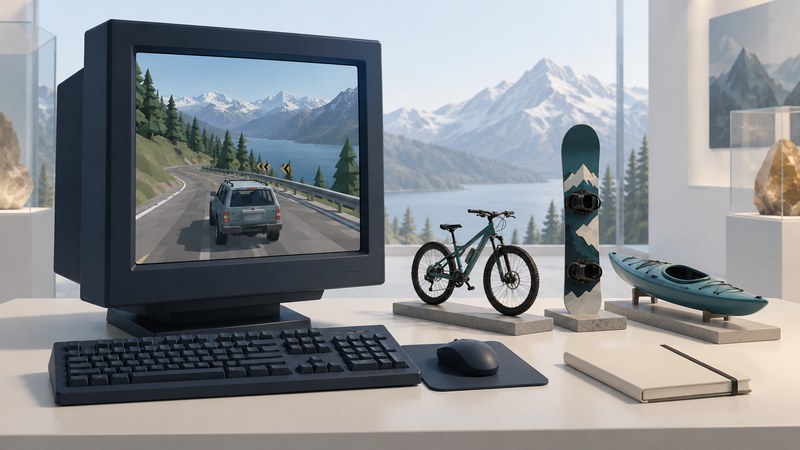
The BMW X3 game provides a compact case study in advertising through play. A vehicle launch became an interactive outdoor adventure, connecting a driving task with the lifestyle the campaign wanted people to associate with the X3.
A 2003 campaign in its historical setting
BMW’s December 2003 account described a browser-based game developed by Skyworks. Players drove an X3 and took part in mountain biking, snowboarding and kayaking activities. Invitations and private scoreboards encouraged friends to participate. The release also described an airport promotion with JetBlue. See BMW’s campaign release, reproduced by AutoIntell.
JetBlue’s own November 25 advisory announced an X3 game preview at JFK Terminal 6 for November 26, 2003. It helps establish the planned event’s place and date; it does not measure the game’s marketing effect. See JetBlue’s event advisory.
This page examines the historical campaign. A verified current playable edition is not provided here.
Connect the play loop to the communication goal
The following reading separates a described campaign feature from an interpretation of its purpose and a possible measure. The interpretations and proposed measures are analytical tools, not reported campaign results.
On a narrow screen, scroll the table sideways. Keyboard users can focus the table region and use the arrow keys.
| Described feature | Possible communication purpose | Evidence to seek |
|---|---|---|
| Driving task | Put the vehicle at the center of the activity | Task starts, completion and participant feedback |
| Outdoor activities | Associate the vehicle with an active leisure setting | Recall of the association among exposed participants |
| Friend invitations and scoreboards | Encourage repeat play and sharing | Invitations sent, recipients who played and repeat sessions |
| Airport preview | Introduce the campaign in a physical setting | Actual interactions, duration and follow-up responses |
A game can communicate through what the player repeatedly does. To analyze that relationship, describe the required action before interpreting its message. “Drive to an activity” is an observable mechanic; “this improved brand preference” is an outcome claim that needs additional evidence.
Measure the outcome you actually mean
Reach, participation and response
Keep potential audience, people who interacted and people whose attitudes changed in different fields. Airport traffic is not a count of game players. Sessions are not necessarily unique people. A completed task establishes participation, while a preference change requires a suitable before-and-after or comparison design.
A small arithmetic example
Suppose a fictional campaign records 1,000 game starts and 600 completions using the same counting rules. Its completion rate would be 600 ÷ 1,000 = 60%. These are invented teaching figures, not BMW results. The ratio says nothing by itself about unique participants, vehicle purchases or why someone stopped playing.
Before comparing two completion rates, check whether a restart creates a new start, whether the same tasks count as completion and whether the observation windows match. Differences in the denominator can make similar-looking percentages answer different questions.
Realism is a separate claim
BMW’s release promoted the game’s simulation of vehicle characteristics. Treat that as a campaign claim unless independent validation is available. Entertaining control feedback, physical-model accuracy and a person’s judgment of the actual vehicle are separate outcomes.
What the surviving record supports
The launch materials explain the campaign’s components and intended positioning. They provide a basis for studying its design. A stronger effectiveness study would add participant counts with definitions, outcome measurements and a defensible comparison. Keeping these layers separate makes the historical example useful to anyone planning or evaluating an interactive campaign.
Map the evidence before drawing a conclusion
Download the advergame evidence record. Record the mechanic, intended message, metric and missing evidence on separate lines. For a different connection between cars and games, see Nissan URGE’s physical cockpit controls.
Explore Autos: vehicle guides, technology and design · Cars: buying, maintenance and ownership