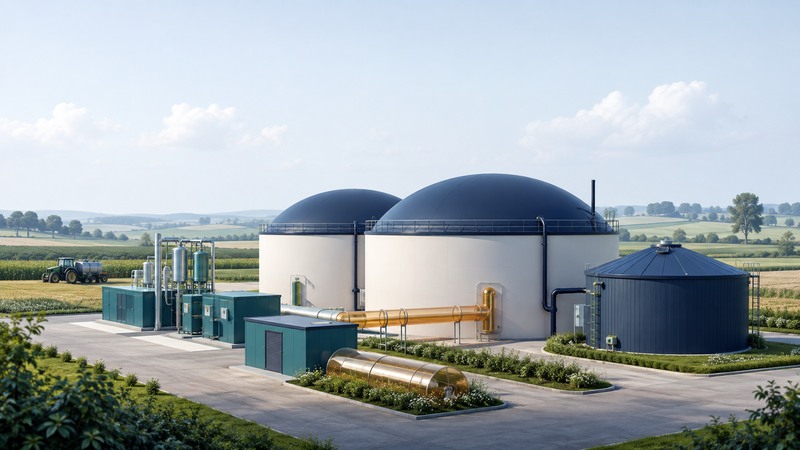
A biogas project converts suitable organic material into a methane-containing gas and a remaining material called digestate. Its usefulness depends on a dependable feedstock, reliable operation, a compatible energy customer and a workable digestate plan. Its climate result also depends on methane losses and what would have happened to the material otherwise.
Start with a one-page flow record naming every input, treatment step and output. This guide supports project review; equipment design, gas handling and operation belong to qualified specialists and the applicable approvals.
Follow the material through the project
EPA AgSTAR’s digestion explanation describes microorganisms breaking down organic matter without oxygen in a designed reactor. Manure, food residues and wastewater solids are examples of feedstocks. Combining materials, or co-digestion, can change gas production and operating requirements.
Raw biogas includes methane, carbon dioxide, water vapor and other constituents such as hydrogen sulfide. Treatment must match the end use. A boiler, engine-generator and pipeline connection can require different gas quality and equipment. Digestate retains liquid and solid material that needs management and may have useful applications after appropriate treatment.
On a narrow screen, scroll the table sideways. Keyboard users can focus the table region and use the arrow keys.
| Stage | Useful record | Decision it supports |
|---|---|---|
| Feedstock | Quantity, composition, contamination checks and supply agreement | Whether the design has a dependable suitable input. |
| Digestion | Design basis, operating evidence, staffing and maintenance plan | Whether expected output is supported by relevant experience. |
| Gas treatment | Inlet analysis, outlet specification and methane recovery | Whether the gas meets the chosen user’s requirements. |
| End use | Connection or purchase agreement; own-use energy | Whether there is a real destination for useful output. |
| Digestate | Analysis, treatment, storage and receiving arrangements | Whether nutrients and remaining material have an acceptable destination. |
For landfill gas, the collection system recovers gas generated within a landfill; the landfill is a different setting from a controlled digester. Compare the relevant collection and treatment data instead of transferring assumptions between them.
Separate raw gas from delivered fuel
DOE’s Alternative Fuels Data Center describes renewable natural gas, or biomethane, as purified biogas. A pipeline or vehicle-fuel project requires the applicable gas-quality specification, compression arrangements and an approved connection or delivery route.
Ask whether a stated volume is raw gas or upgraded product and whether it is dry or wet. Retain its temperature and pressure reference, methane concentration and energy basis. Comparing two volumes without those conditions can misrepresent useful fuel output. Record carbon dioxide removed, methane retained in the product and methane in off-gas or other losses.
Fictional methane balance: 1,000 standard cubic metres of dry raw gas at 60% methane contains 600 standard cubic metres of methane on the same reference basis. At an assumed 98% recovery into product, 588 standard cubic metres of methane reaches that product and 12 does not. That missing 12 must be traced to oxidation, flaring, venting or another stream; it cannot be labeled an atmospheric release without evidence.
This is a component balance. Total upgraded-gas volume also depends on product purity. Electricity for treatment and compression, digester heat and further distribution losses still belong in the project review.
Test the climate claim against a stated baseline
EPA’s RNG facility-operation best practices explains that feedstock, collection, upgrading, electricity supply and methane leakage affect greenhouse-gas results. Sufficient losses can undermine an expected benefit. Request measured leakage information, detection coverage, repair records and the treatment of abnormal operation.
Identify the alternative pathway: for example, a particular manure-storage arrangement or disposal system. Ask how its emissions were estimated and what gas recovery it already has. Include feedstock transport, digestion, treatment, digestate storage, fuel delivery and the displaced energy service. State the greenhouse-gas metric and time horizon used to combine methane and carbon dioxide effects.
Read results per unit of delivered energy and, when relevant, per unit of waste managed. Keep avoided-baseline emissions separate from the project’s own emissions. An accounting result tied to one feedstock and disposal baseline needs recalculation if either changes.
Check the operating and commercial commitments
The AgSTAR project development handbook treats feedstock, technology, feasibility and agreements as connected decisions. Request evidence that resembles the proposed feedstock and scale, together with operator training, scheduled maintenance, spare parts and contingency handling during downtime.
Confirm who pays for rejected loads, digestate transport, off-spec gas and interruption of the energy customer. Itemize installation, feedstock collection, utilities, labor, consumables, maintenance and financing. Separate contracted revenue from assumed credits or incentives and verify eligibility with the administering authority.
A useful next step is a feasibility brief with unresolved items assigned to a supplier, operator, customer or regulator. Compare municipal waste combustion only where it is a realistic alternative for the same materials; different feedstocks can call for different pathways.
Biogas project evidence brief
Biogas project evidence brief — plain-text download. Save a copy and fill it in with your own information. The file includes instructions, assumptions and references so it can be used independently.