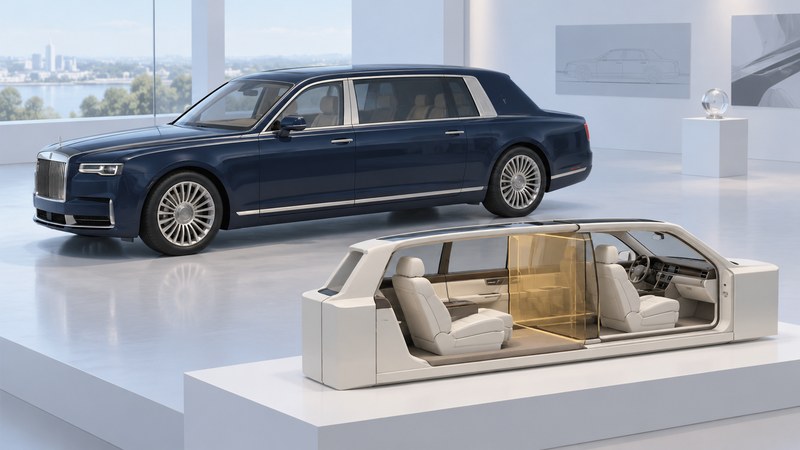
An extended wheelbase tells only part of a limousine's story. Where the added length sits, where the passengers sit and how the door opens into their space all affect the experience. The Bentley Arnage Limousine is especially useful for understanding why a bespoke car needs its own configuration record.
A show vehicle, then a production announcement
Bentley Mulliner presented the Arnage Limousine concept at Geneva in March 2004. A December announcement described a planned run of 20 individually numbered commissions. It also stated that the subsequent cars would incorporate the Arnage's 2005 model-year revisions. Read the Bentley announcement reproduced by Next Car as a period plan: it does not, by itself, prove a final production total or the specification of any surviving car.
Three descriptions can therefore all be relevant without being interchangeable: the original show vehicle, the announced production design and a customer's completed commission. Keep the date and subject of each document beside its claims. A photograph of the show interior cannot settle an equipment question about a later commission.
Where the added length went
The announcement gives a 3,566 mm wheelbase and allocates the extension as 200 mm at the rear D-pillar, 200 mm in the rear doors and 50 mm in the front doors: 450 mm in total. It describes a recessed rear seating area behind the widened pillar, with a smaller privacy window. These figures describe that announced design.
On a narrow screen, scroll the table sideways. Keyboard users can focus the table region and use the arrow keys.
| Area | Design question | Evidence to seek on the actual car |
|---|---|---|
| Rear door | Does the opening align conveniently with the passenger seat? | Side view with door open; measured opening and seat position. |
| Rear pillar and window | How much of the seated passenger is behind the pillar? | Seated eye-level view and exterior side view. |
| Passenger compartment | Where is the usable space after equipment is installed? | Seat arrangement and measurements with tables or footrests deployed. |
| Driver/passenger division | Is there a partition, and what space does it occupy? | Build specification and photographs; do not infer it from the word limousine. |
The table is an observation method, not a list of universal Arnage features. Extra length behind a door can make a passenger feel more sheltered while leaving a different entry path from a design that places all its extension in the door. Judge those relationships from the actual arrangement rather than translating wheelbase directly into comfort.
Use millimetres consistently when reconciling dimensions. The three published additions sum to 450 mm; that arithmetic does not establish a car's total length, turning circle or usable legroom. Each of those needs its own measurement or specification.
Identify the model before comparing equipment
Bentley Heritage's Arnage Limousine catalogue distinguishes the model and provides year and chassis-based selection. Its broader model-year listing should not be read as proof that the specific 2004 show configuration existed unchanged across every listed year.
Write the exact designation used by the factory record. Do not silently substitute an Arnage RL document, a general Arnage brochure or a State Limousine description because each concerns a long or formal Bentley. Those names are not sufficient evidence of matching dimensions, bodywork or equipment.
For a particular vehicle, assemble a side-view photograph, a cabin plan or measured sketch, an identity reference, dated specification documents and records of later alterations. Mark items as documented at completion, visible now, or unresolved. That separation prevents a modern replacement screen from being mistaken for evidence of the original installation.
Read an equipment claim narrowly
The period announcement distinguishes the concept's rear bench from the split rear seats described as standard, and discusses optional footrests and other equipment. That is a reason to inspect each commission, not a reason to populate an individual car's equipment list from the announcement.
For example, suppose a listing says “full rear entertainment” and shows two screens. You can record two visible screens. You still need separate evidence for their installation date, working functions and relationship to the original build. Likewise, a reference to privacy does not establish acoustic isolation, a partition or protective equipment.
A useful caption would say “rear bench visible in dated photograph; build specification not yet located.” This preserves an observation without turning it into a factory claim. Where records conflict, keep both versions and identify the next document or inspection needed.
Record the car's particular arrangement
Download the Arnage Limousine configuration record for dimensions, seating, evidence dates and alterations. For the broader process of defining a bespoke commission, use the Bentley Mulliner guide. This record concentrates on recognizing the body and cabin that were actually built.
Explore Autos: vehicle guides, technology and design · Cars: buying, maintenance and ownership