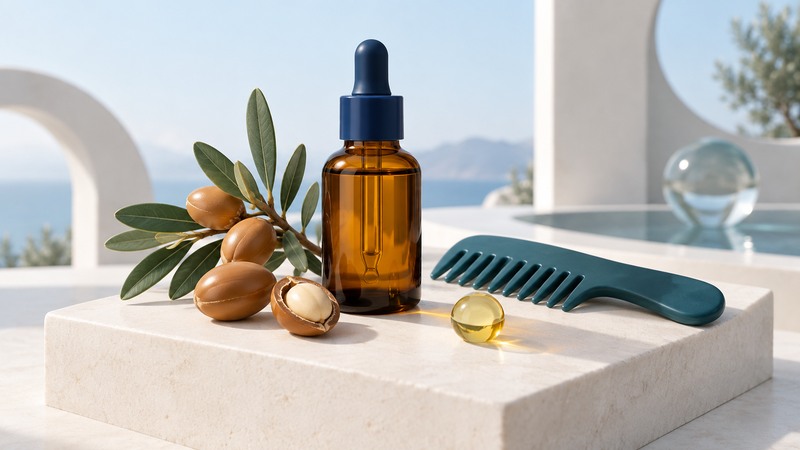
Treat argan oil as a cosmetic option to evaluate for skin comfort or hair finish. Choose a product intended for that use, follow its directions and judge a specific result. Claims about growing hair, removing scars or protecting against sunlight require their own evidence.
Start with the whole product
A bottle of oil, a silicone-based hair serum with some argan oil, and an argan-containing face cream are different products. Read the ingredient list and directions together. The ingredient name Argania spinosa kernel oil identifies the oil; the formula around it changes texture, application and performance.
On a narrow screen, scroll the table sideways. Keyboard users can focus the table region and use the arrow keys.
| Format | What to evaluate | What to avoid assuming |
|---|---|---|
| Cosmetic oil | Intended body area, ingredients, dispensing and storage directions. | That purity or organic wording guarantees tolerance. |
| Hair serum | Finish, combing feel, heaviness and instructions for damp or dry hair. | That every benefit comes from argan oil alone. |
| Cream or lotion | The complete moisturizing formula and how it fits your existing routine. | That more oil automatically means better care. |
Cosmetic oil is for its labeled external use. Culinary argan oil is a food product. Keep those uses separate; the presence of oral dosing in a research paper is not a reason to drink a cosmetic product or add a supplement to your routine.
What a human study actually measured
A 2014 study of 60 postmenopausal women measured forearm skin hydration and water loss over 60 days. Participants were assigned to consume either argan or olive oil, and both groups applied argan oil to one forearm. The authors reported improvements in hydration measures associated with topical application.
This was an open-label study in a specific population, with dietary and topical components. It offers a limited signal about hydration, not a test of acne treatment, scar removal, hair regrowth or an SPF rating. It also does not show that a modern fragranced serum performs like the oil used in the study.
Ask three questions of an ingredient claim: was it tested in people, was the same preparation used, and was the outcome the one you care about? A finding about an isolated hair fiber or a laboratory antioxidant assay answers a different question from visible regrowth or fewer symptoms in a person.
Make a modest, observable trial
- Choose one goal: for example, a less dry feel on intact skin or a smoother-looking hair finish.
- Keep your other products stable and use a product labeled for the intended area. Review fragrance and other ingredients if you have sensitivities.
- For hair, follow the stated quantity and placement. Begin at the lower end of the labeled amount and assess the result after ordinary drying and styling before adding more.
- For skin, consider the AAD small-area product test before broader use. Stop if redness, itching or swelling develops.
- Record comfort and the cosmetic result separately. Keep the product only if it earns its place in the routine.
Keep protection and treatment in their own roles
Use labeled sunscreen for sun protection. A botanical oil’s composition cannot supply an SPF claim; the AAD sunscreen guidance gives the protection criteria to look for. Persistent scalp irritation, sudden hair loss, a rash or painful acne deserves an appropriate diagnosis rather than repeated oil experiments.
Store the bottle as instructed and keep its opening clean. Judge supplier claims such as traceability or cooperative sourcing by documentation, not by rustic packaging. For a broader routine see basic skin care; for projects that involve mixing ingredients, read homemade-cosmetics planning first.