The 50th Baja 1000 in 2017 connected two stories: a demanding peninsula race from Ensenada to La Paz, and a history in which Volkswagen-based vehicles helped make desert racing accessible and distinctive. Understanding the anniversary means looking at the event’s actual results as well as the very different machines competing within it.
The 2017 event in the official record
SCORE's November 18, 2017 results report gives a 1,134.40-mile course from Ensenada to La Paz. It names Carlos “Apdaly” Lopez and his father Juan C. Lopez as the four-wheel overall and Trophy Truck winners, with a time of 19:53:36. Francisco Arredondo's team won the motorcycle overall classification with an official time of 21:07:17.
The report records 405 starters and 238 official finishers in its race-report section. It also explains that final results followed tracking review and penalty assessment. The precise distance and final classification are more useful historical references than an approximate course length or a result observed before review.
Keep the event year attached to the route. Baja 1000 courses vary, and a historical account is not a current route, access or spectator plan.
A single race contains several meaningful competitions
Begin with the classification being discussed. A four-wheel overall result, a motorcycle overall result and a class result answer different questions. Their labels belong beside the finishing time whenever results are summarized.
On a narrow screen, scroll the table sideways. Keyboard users can focus the table and use the arrow keys.
| Record | What it answers | What to retain |
|---|---|---|
| Overall category result | Who ranked first within the stated broad classification? | Four-wheel or motorcycle scope, official status and adjusted time. |
| Class result | Who ranked first among entries under that class's requirements? | Class name, year, vehicle identity and final classification. |
| Finisher record | Which starters met the event's requirements for an official finish? | Start/finish definitions, time limit and any penalties. |
| Season result | How did an entry perform across the championship? | Points rules and the complete season, separate from one race. |
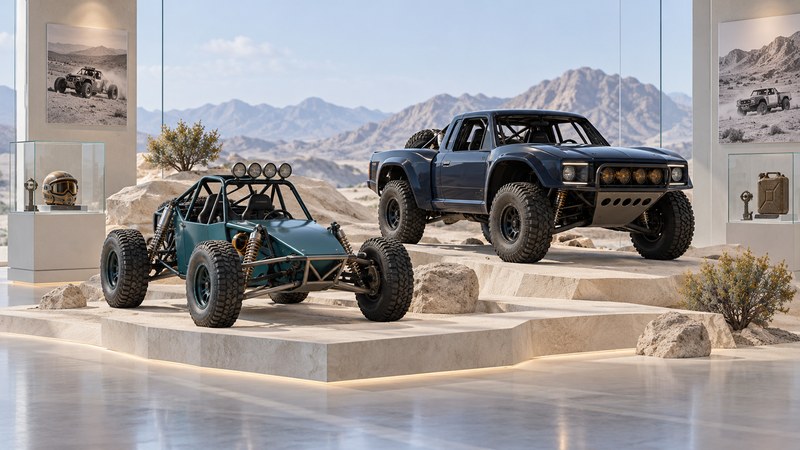
A truck, a buggy and a Beetle-shaped racer can occupy the same landscape while competing under very different constraints. Read the class record before drawing conclusions from their relative times. “Volkswagen-based” is a historical or engineering description; the applicable class rules determine the competitive category.
For an accessible current example, SCORE's Class 11 overview describes VW Type 1 sedans with restricted modifications. Use the correct year's detailed rules when researching a specific race. Today's overview helps explain the category but does not replace the 2017 rulebook.
Trace the Volkswagen connection through named records
The SCORE historical champions list records Vic Wilson and Ted Mangels in a Meyers Manx VW for 1967, with a time of 27 hours 38 minutes. That entry gives the anniversary story a concrete starting point: named people, a named machine and a recorded outcome.
Volkswagen's Beetle history connects Bruce Meyers' Beetle-based dune buggy with the 1967 Mexican 1000 and later off-road Beetle racers. The Manx's buggy body and a modified Beetle body are different forms, even when Volkswagen components connect their stories.
- 1967: a documented starting point. Read the Manx result in the organizer's historical list and connect it to the manufacturer's account of Beetle-based development.
- The continuing class story. Examine how a recognizable production-based vehicle can remain part of desert competition under a defined set of restrictions.
- 2017: an anniversary with its own results. Return to the final report for the actual peninsula course and category winners, rather than using early history as a substitute for the race outcome.
These records explain why Volkswagen belongs in the story without turning the whole event into a one-brand history. Each type of vehicle raises different questions about packaging, durability, support and the limits set by its competition class.
Build a comparison that respects the event
For any two race records, collect the year, organizer, course configuration, official distance, vehicle class, driver or team, finishing status and adjusted time. Keep the original source beside the summary. Resolve an apparent contradiction by checking whether one source describes an entry, an early estimate, a provisional result or a final classification.
The 2017 anniversary is therefore both an event history and a lesson in reading motorsport evidence. The most informative record connects people, machinery, rules and a particular course. For the wider practice of interpreting vehicle ideas, see the automotive-design guide.