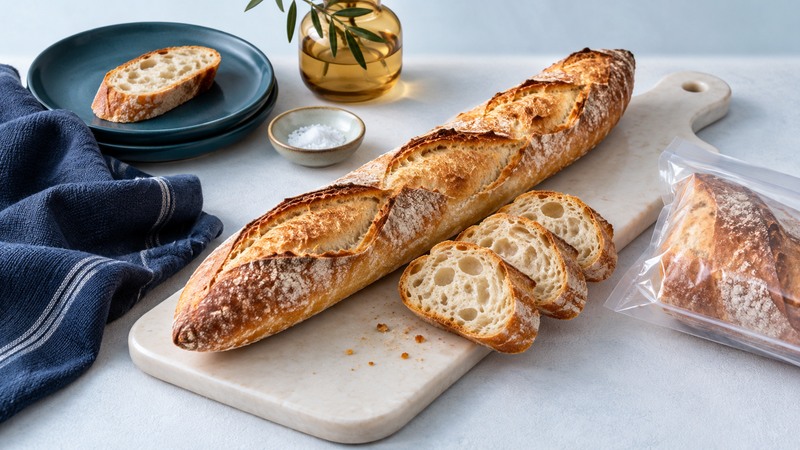
Buy a baguette close to the meal when a crisp crust matters. Before cutting it, decide how much you will eat today and freeze the rest in useful portions. A brief oven refresh can improve sound day-old bread; planning the portions early produces a more reliable result.
Choose the loaf for its job
Scroll the table sideways. With a keyboard, focus the table and use the arrow keys.
| Meal | What to look for | Useful question for the bakery |
|---|---|---|
| Bread alongside soup or salad | A crisp, well-colored crust and a loaf size you can finish. | When was this batch baked? |
| Sandwiches | A width that fits the filling and a crumb whose holes will hold it. | Can I see a cut loaf or choose a slightly tighter crumb? |
| Toasts or crostini | A consistent width for pieces that toast evenly. | Is there a smaller loaf if I need only a few servings? |
Ingredients and loaf styles vary: flour, water, yeast or starter and salt are common, while some products add other ingredients. Read the actual label when avoiding an allergen or comparing sodium. A rustic appearance tells you little about a commercial loaf’s full formulation. For a nutrition comparison, use the bread label and portion method.
Divide today’s bread from later portions
Illustrative plan: a 300 g baguette divided into three 100 g lengths provides two sandwich portions for today and one to freeze. Alternatively, twelve 25 g slices use the whole 300 g loaf. These are planning quantities; weigh your loaf because length alone does not determine weight.
Let freshly baked warm bread cool before sealing it. Keep today’s baguette in its paper bag at room temperature. For longer keeping, wrap cooled portions tightly and freeze, labeling the date and intended use. Slice before freezing if you want individual toasts. King Arthur’s bakery storage guidance recommends same-day paper-bag storage for baguettes and well-wrapped freezing for up to three months as a quality guideline. A domestic refrigerator speeds staling; freezing is more useful for planned storage.
Refresh sound bread just before serving
For a room-temperature, day-old baguette, preheat a conventional oven to 350°F (about 175°C). Remove every bag, tie and plastic wrap. Put the bread on a baking sheet, loosely tent with foil, and warm for 5–10 minutes, checking early for a small portion. This is the bakery’s baguette refresh method. Serve while pleasantly warm and crisp; the improvement is temporary.
For frozen bread, thaw the wrapped portion at room temperature, then unwrap completely and use the refresh above as a starting check. Avoid repeatedly thawing the whole supply. Toaster ovens may brown close surfaces faster; follow their rack and clearance instructions and watch the first portion. Yenra has checked the published method but has not kitchen-tested it on different ovens.
Use drier bread where texture helps
- A two-person tomato toast: use four slices totaling about 100 g, brush with 2 teaspoons olive oil and toast on a metal sheet at 375°F for roughly 6–10 minutes, turning once. Check frequently until crisp. Top just before eating with 150 g chopped ripe tomato and herbs; season to taste. This is a suggested preparation.
- A sandwich: cut a 100 g length lengthwise and layer with a filling that is ready to eat. Drain wet vegetables and put a lettuce leaf or other suitable barrier against the crumb if packing. Keep perishable fillings cold.
- Breadcrumbs: use sound dry bread for crumbs when a recipe calls for them; measure the resulting crumbs according to that recipe rather than substituting slice counts.
Distinguish dry bread from spoiled bread
Dry, firm bread with normal color and smell may suit toast. Mold, an unusual odor or spoilage calls for disposal. Discard the whole moldy loaf or package rather than trimming the visible patch. Bread is porous, and contamination can extend beneath the visible growth; USDA’s mold guidance specifically lists bread and baked goods for disposal. Heating is not a remedy for spoiled bread.