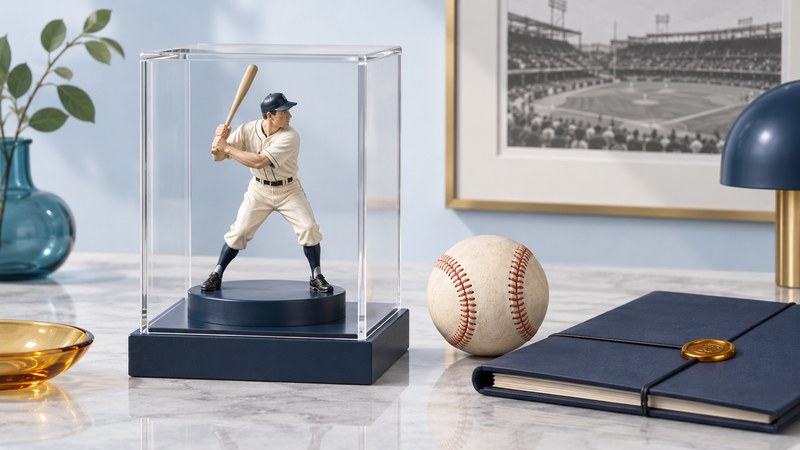
A Babe Ruth miniature combines baseball history, game design, and the history of one physical collectible. The SportsClix Red Sox figure is best understood through its dated announcement and the evidence accompanying an actual example: maker, edition, packaging, condition, and ownership records.
The SportsClix figure and its announced context
A November 11, 2004 Topps announcement, preserved in Pojo's contemporaneous reproduction of the press release, described a hand-sculpted, hand-painted Babe Ruth miniature in a 1917 Boston Red Sox uniform. Topps announced an edition of fifty for the 2005 MLB SportsClix game and a charity auction for number one, benefiting the Boys and Girls Club of America.
Those statements document what the company announced. They do not establish how many examples survive, where an offered figure originated, or the result of the auction. A present-day seller's object needs its own supporting record.
The same contemporary page carries the announcement for the 2005 SportsClix game. This places the miniature in a collectible-game setting, which matters when comparing it with statues, ordinary game pieces, and other baseball memorabilia. Keep the precise product identity in the record rather than grouping every Ruth figure together.
Ask for evidence specific to the offered figure
Begin with photographs of the complete figure from several sides, its base and underside, the package, and any label or certificate. Ask the seller to distinguish what can be read on the object from what was inferred from a previous listing.
| Claim | Useful evidence | Remaining question |
|---|---|---|
| Maker and product line | Base markings, original packaging, and contemporary manufacturer material | Do those references match this version? |
| Numbered edition | Clear image of the marking and documentation explaining the numbering | Is the marking original and specific to the announced edition? |
| Original condition | Detailed images, disclosed repairs, and earlier photographs | Has paint, attachment, or structure changed? |
| Ownership history | Dated receipts, auction lot records, and correspondence linked to the item | Where are the gaps between documented owners? |
A certificate is evidence to examine, including its issuer and the object it describes. A generic card or an unsupported “rare” label has a narrower role than a record tied to the physical piece.
Describe condition in concrete terms
Inspect the figure's extremities, the connection to its base, paint surfaces, and any moving or game-related components without forcing them. Record cracks, chips, missing pieces, loose attachments, discoloration, and disclosed repairs. Photograph concerns close up and again in a wider view so their location is clear.
Ask about replacement parts or repainting. A carefully repaired figure may still suit a display collection, but that history belongs in the description and price comparison. Preserve packaging even when worn, and photograph its labels before placing it in storage.
Support a miniature by its base when moving it, and avoid handling delicate projecting parts. Keep it in a stable display location protected from dust, direct sunlight, and accidental contact. For loose paint or structural damage, seek conservation advice before applying cleaners or glue.
Build a provenance file you can hand to the next owner
- Assign a permanent item ID and use it in every photograph filename.
- Write a description of the observed figure, including markings and measurements with units.
- Add the seller's claims as attributed statements, with the listing and date.
- Save receipts and correspondence without exposing private contact details in public posts.
- List unresolved questions and any later expert findings.
This method also helps with coins. The 1913 Liberty Head nickel guide explains how object identity, documentary history, and authentication work together.
Compare like objects before considering price
Look for completed sales of the same product and version, with comparable condition, packaging, and documentation. Record the sale date, currency, buyer's fees, and shipping where relevant. When the comparison is a different miniature or a differently documented edition, say so explicitly.
Edition size alone does not determine what a buyer will pay. Demand, condition, completeness, and confidence in identity all affect a comparison. If the available evidence cannot establish the premium being asked, consider a better-documented example or a simpler collecting goal.
For a compact display, pair an identified miniature with a short, sourced account of its game and announced historical subject. Keep the original records privately and show copies where appropriate. The resulting collection preserves an object's story along with its appearance. Explore the Collecting library for related approaches to coins, stamps, and reference specimens.