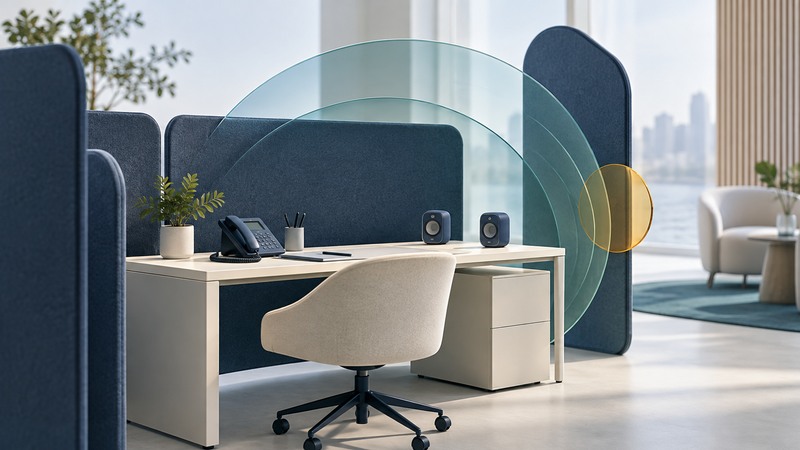
Babble was a desktop sound-management product introduced in 2005 to make nearby conversation harder to understand. Its history raises a durable office-design question: what can someone at a neighboring desk actually make out? Assess that question through speech intelligibility, room conditions, and the sensitivity of the conversation.
What the historical product proposed
Herman Miller’s company history places Babble’s introduction in 2005 and describes its purpose as supporting confidential conversation in open work environments. A 2005 Herman Miller investor presentation described its approach as turning an individual voice into crowd-like sound. The company distinguished that voice-based approach from conventional white- or pink-noise masking.
That describes the manufacturer’s intended function. It supplies no measurement for your room. Treat claims about confidentiality as questions for evidence: the listener’s position, the speaker’s level, the background sound, and the method used to judge intelligibility all matter.
For someone examining a surviving unit, begin with its exact model, original documentation, condition, and supported operating procedure. This retrospective supplies neither a present availability claim nor instructions for an undocumented device.
Separate three different outcomes
Masking adds sound that can make speech less intelligible. Absorption and layout influence how sound travels and reflects. Enclosure creates a different physical separation between a conversation and adjacent listeners. Evaluate the combination in the actual space.
The National Research Council Canada’s research on conventional open-plan office acoustics examines interacting factors including ceiling absorption, screens, workstation geometry, and background noise. Its practical implication is to assess the room as a system: one desktop product cannot establish the performance of all those conditions.
On narrow screens, scroll horizontally. Keyboard users can focus the table region and use the arrow keys.
| Claim or observation | What it establishes | Useful next check |
|---|---|---|
| Speech sounds quieter | A listener’s impression of level | Can the listener still understand words? |
| A device produces masking sound | The device is operating | What is intelligible at relevant locations? |
| One nearby listener misses the message | One trial under recorded conditions | Other positions and ordinary operating conditions |
| The office feels less distracting | A perceived comfort or attention benefit | Whether the privacy requirement is also met |
A quieter impression and reduced intelligibility answer different questions. Keep comfort, distraction, and confidentiality as separate objectives in the evaluation record.
Define the privacy need before testing
List the conversation types the workspace must accommodate. Routine scheduling, personnel discussions, and commercially sensitive negotiations may need different arrangements under an organization’s policies. Choose an appropriately private space for sensitive discussion while any proposed open-area solution remains unverified.
For an informal planning review, use invented, non-sensitive phrases with the participants’ knowledge. Record the speaker and listener positions, normal background conditions, and whether words can be understood. Keep the speaking task and positions stable when comparing a layout change. Do not use real confidential information as test material.
This exercise can reveal an obvious gap and help brief an acoustics professional. A privacy assurance or procurement requirement needs a defined assessment method, relevant measurement conditions, and an accountable reviewer. Agree on that evidence before treating a demonstration as acceptance.
Read a fictional desk trial
Ask for evidence that matches the installation
Request the tested configuration, room assumptions, listener locations, assessment method, and resulting intelligibility or privacy measure. Ask who will verify the installed system and what changes would require reassessment. Occupancy, partitions, furniture and building systems can alter the conditions used for acceptance.
Babble is useful as a historical example of bringing speech privacy to the desktop. The lasting decision is whether a proposed combination of space, equipment, and working practices meets a clearly defined need. Keep the evidence and the operating policy together so future layout changes receive an informed review.