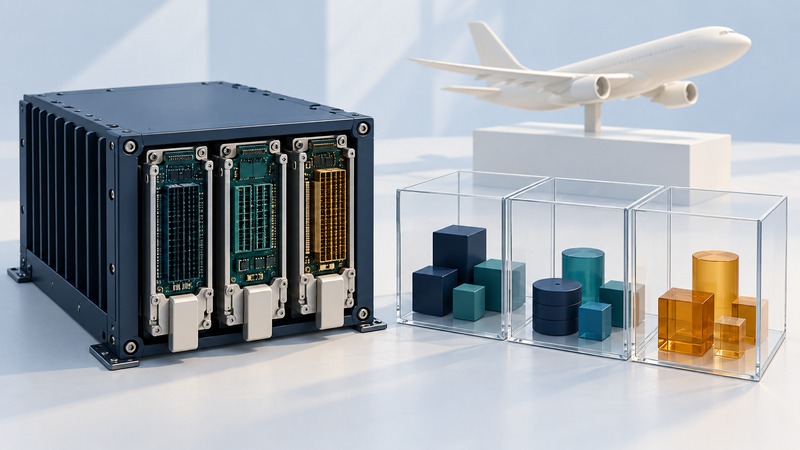
An avionics computer must deliver the right result within the time required by its function. Understanding airborne computing therefore means looking at deadlines, controlled sharing of resources, fault response, and the evidence used to support the complete aircraft installation.
This is an explanation of architecture and assurance for readers and students. The numerical schedule below is an invented teaching example, with no connection to an aircraft configuration or approved design.
A deadline is part of the result
Imagine software that reads a sensor, computes a value, and sends that value to another function. Its response time includes waiting for input, waiting to execute, doing the computation, and delivering the output. A fast average calculation can coexist with an occasional response that arrives too late.
For a timing requirement, ask when the clock starts, when it stops, what the deadline is, and which operating and fault conditions the analysis covers. Processor clock speed alone leaves those questions unanswered. Contention for memory or an input/output device can also consume time.
Share a computer through defined boundaries
Integrated modular avionics, or IMA, allows multiple functions to use a shared computing platform. Spatial partitioning controls access to memory and resources; temporal partitioning controls execution time. Communication between partitions uses defined mechanisms so that the intended exchanges can be examined.
Wind River's technical paper on safety-critical software and IMA describes these ideas in the context of ARINC 653 and a partitioned operating system. Its account is useful for understanding an implementation approach; a particular product's configuration and assurance evidence still need their own review.
A partition is a controlled environment within the computing system. Redundancy supplies additional resources or channels for a defined fault response. These address different parts of the design: software separation within one computer does not create an independent second power supply, sensor, or processor.
Read an illustrative time schedule
Suppose a teaching model repeats a 20-millisecond frame. Its windows are allocated as follows. We simplify away execution overhead here to make the arithmetic visible; a real timing budget would account for overhead and other interference.
Scroll the table horizontally. Keyboard users can focus it and use the arrow keys.
| Window | Illustrative purpose | Allocated time |
|---|---|---|
| 0–5 ms | Partition A: read and process an input | 5 ms |
| 5–9 ms | Partition B: prepare a display value | 4 ms |
| 9–15 ms | Partition C: process a communications message | 6 ms |
| 15–20 ms | Unallocated time in this simplified example | 5 ms |
The allocated application windows total 15 ms, or 75 percent of the frame. That fraction says how much time the schedule assigns. It does not show whether each function meets its end-to-end deadline.
Follow evidence from a component to the installation
The FAA's AC 20-170 addresses IMA development, verification, integration, and approval using RTCA/DO-297 and TSO-C153. The FAA identifies it as an acceptable means of compliance, and expressly distinguishes that guidance from a regulation. Its subject includes the integration process, beyond the capabilities of an individual operating system.
When reading a platform claim, identify its boundary. Does it concern an operating-system interface, a processor module, a reusable development package, an application, or an installed system? Then look for the assumptions imposed on the next participant: resources, timing, permitted interfaces, fault behavior, and configuration.
A useful reading record has four entries: the claimed property, the exact item and version, the evidence supporting it, and the conditions under which that evidence applies. For example, evidence about memory separation leaves shared hardware failure and application correctness as separate questions.
Questions that make a technical account clearer
- Which function needs the result, and by when?
- Which resources are shared, and which mechanism controls access?
- What happens when a task exceeds its budget or an input is missing?
- Which faults are covered by separation, and which by redundancy or another response?
- What changes when a module, application, or configuration is replaced?
These questions help interpret a description without treating a brief product announcement as a system safety argument. For another context in which timing and fault recovery matter, read Computers on Mars. For a contrasting performance problem, Cluster Computing explains throughput and scaling.