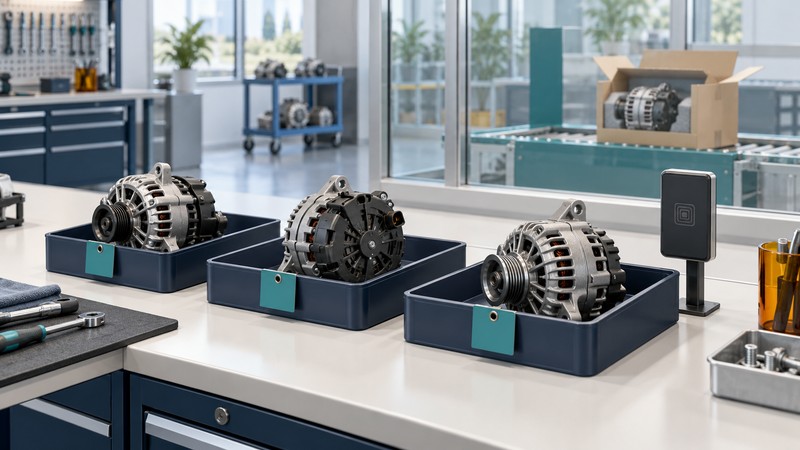
A useful remanufacturing traceability pilot shows which returned component entered the process, what happened to it and which finished unit left. Start with those questions and the decisions they support. Then choose how barcodes, RFID and operator confirmations will capture the necessary evidence.
Define what keeps its identity
A part number identifies a type of component; an individual identifier distinguishes one unit from another. A work order, tote and finished assembly may each need their own identity. Write down those meanings before buying tags so the same code is not used ambiguously for a core, its container and a replacement assembly.
In an illustrative alternator process, a returned core receives a unit record at intake. Disassembly may separate its housing from replaceable internal parts. Decide which object the unit identity follows, which parts need individual or batch records, and how replacements are linked to the resulting assembly. Have production and quality staff approve the rule together.
If a tray is tagged, record when a specific component enters and leaves it. Reusing the tray requires closing the previous association. If the component changes containers, capture the transfer. That simple rule prevents a perfectly readable tray tag from referring to yesterday’s contents.
Map the events that answer real questions
GS1’s EPCIS standard provides a model for sharing events about identified objects, their time, location and business context. Use that distinction when discussing integration: a reader observation becomes useful only when the application can relate it to an appropriate process event. An EPCIS implementation requires its defined syntax and vocabularies; the worksheet here is a planning aid.
On a narrow screen, scroll the table sideways. Keyboard users can focus the table region and use the arrow keys.
| Step | Evidence to preserve | Exception to design for |
|---|---|---|
| Core intake | Unit identity, claimed part type, receipt and initial assessment. | Unreadable mark or uncertain identity needs controlled review. |
| Disassembly and cleaning | Relevant component relationships and transfers between carriers. | Mixed parts or a lost tag must not silently acquire another identity. |
| Rebuild | Work order, relevant replacement-part records and completed operations. | Rework or substitution needs an explicit record. |
| Inspection and test | Applicable test result and authorized disposition linked to the unit. | A read alone cannot release an untested or failed unit. |
| Packing and shipment | Finished identity, package association and shipment record. | Wrong-unit or wrong-container matches need a hold and correction. |
For each step, name the person or system responsible for the record and the action allowed next. A tag read establishes that an identifier was detected under certain conditions. Quality release comes from the relevant inspection or test evidence and authorized decision. Keep those records linked and distinguish their roles.
Fictional planning record: unit CORE-042 is associated with tray T-17 at intake. At rebuild completion, the work order records the installed replacement items. At the test station, a result record is attached to CORE-042; the responsible system assigns its disposition. Packing associates the finished unit with carton C-088 and closes the tray association. These labels are invented and this prose is not an EPCIS message.
Choose a capture method for each step
GS1’s comparison of RAIN RFID and barcode capture explains the optical-line-of-sight distinction and the need to choose for the application. A barcode scan can suit an intentional one-unit confirmation. RFID may help where repeated handling or visibility makes optical scanning awkward. A mixed process can preserve both automated capture and a readable fallback.
Passive and active tags have different power arrangements; specify the actual system being evaluated. Request a datasheet for each proposed tag, attachment and reader configuration. List the actual cleaning chemicals, temperatures, cycle duration, abrasion, fluids and nearby metal. GS1’s harsh-environment guidance discusses protective coatings and enclosures for tags. A remanufacturing line needs evidence for its own exposures. Obtain vendor evidence for those conditions and test representative process cycles.
Evaluate read zones with the real fixtures, orientations, moving speeds and adjacent work. Include empty carriers, multiple tagged items and a nearby item that should remain outside the event. Successful detection must also identify the correct unit at the correct step. Keep inspection holds and the fallback procedure usable during reader or network outages.
Measure the process, including its mistakes
Choose one component family and a bounded route. Record the existing workload and exception rate first. Agree with production, quality and IT on acceptable capture accuracy, false associations, recovery effort and record completeness before running the pilot. Name an owner for each failure type and preserve the original event when a correction is made.
Define duplicate handling and offline recovery with the application team. Several reads of the same item during one passage should not create several completed process steps. A delayed upload should retain the event’s actual time and identity. Corrections need an attributable history, and access to change identity or release status should be restricted to the appropriate roles.
Hypothetical pilot: observers independently count 200 expected unit passages. The system produces 194 correct, unique automatic events; six passages require recovery. Initial automatic capture is 194 ÷ 200 = 97%, and the recovery share is 6 ÷ 200 = 3%. Separately record two false events attributed to items outside the intended passage. They are errors, not extra successful captures.
Reconcile every expected passage with its event or recovery record. Report false events, duplicate events, manual work and test conditions alongside the headline percentage. These invented numbers illustrate measurement; acceptance thresholds depend on the actual process and consequences. Successful manual recovery improves final completeness but does not change the initial 97% automatic result.
Scale only after the evidence is usable
The traceability pilot worksheet brings identity rules, event ownership, exposure tests and acceptance evidence together. Compare the useful reduction in searching, re-entry and correction work with tags, installation, integration, training, maintenance and ongoing exception handling.
Keep the pilot narrow if identity breaks at disassembly or neighboring items trigger false associations. Resolve that failure and repeat the affected test before widening the route. For foundational terminology, use the RFID technology and application guides; this application depends on the integrity of the remanufacturing records as much as on radio performance.
Explore Autos: vehicle guides, technology and design · Cars: buying, maintenance and ownership