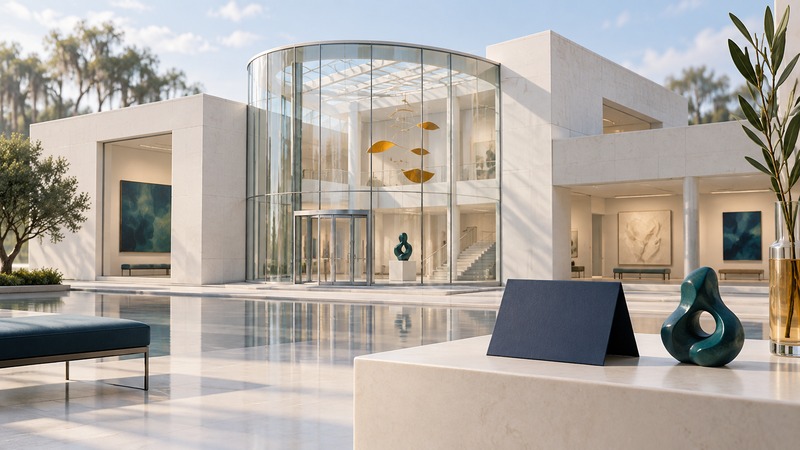
Plan a Jepson Center visit around one main interest—an exhibition, the building, or a family art experience—and leave room to look slowly. The museum brings modern gallery space and the Telfair Children’s Art Museum into Savannah’s historic district.
The Jepson Center is at 207 West York Street, Savannah, Georgia. It opened in 2006 and was designed by Moshe Safdie. Start with Telfair’s Jepson Center page for its history and current programs, then check the official hours and admission page for the date you intend to visit.
Settle four questions before leaving
- What is open on your date? Read the dates of the specific exhibition or activity you want to see. A museum overview and an individual exhibition listing may be updated on different schedules.
- Which ticket fits your visit? Review the current admission options, eligibility requirements and validity period. Check whether another Telfair site requires a separate timed-tour arrangement.
- How will you arrive? Use the museum’s directions and parking link to plan the final approach, not just the drive into Savannah.
- What access arrangements matter? Confirm a suitable entrance, circulation route, seating, restroom access or other required accommodation with the museum before travel.
Save the visit date, selected exhibition, ticket information and arrival plan in one note. Add a fallback activity if the main gallery is unavailable or a child needs a shorter visit. A flexible plan is more useful than scheduling every minute.
The official admission page describes access across Telfair’s three sites and provides current ticket conditions. Review those conditions rather than assuming that a multi-site ticket also reserves a place on every tour. In particular, the Owens-Thomas House & Slave Quarters has its own tour procedures and a historic building layout.
Choose a route that matches your time and attention
The following schedules are planning examples, not museum-led tour durations. Adjust them for gallery availability, mobility, energy and the amount you want to read.
On a narrow screen, swipe the table sideways or focus it and use the arrow keys.
| Your priority | Suggested allocation | What to leave with |
|---|---|---|
| One exhibition, about 60 minutes | 10 minutes orientation; 35 looking; 15 revisiting favorites | Three works you can describe and one question to pursue |
| Architecture and art, about 90 minutes | 15 minutes building; 50 galleries; 25 reflection and a second look | A connection between the space and the way the art is experienced |
| Family visit, about 75 minutes | 10 minutes orientation; 30 interactive activity; 20 quiet looking; 15 flexible time | One shared observation and an idea for making something later |
Ask the front desk which galleries fit your interests and whether any spaces are closed. Choose a small number of works to look at closely. A second look at one painting often adds more than rushing through an extra room.
Use a simple looking routine: describe what is visible, identify a choice the artist made, then ask what evidence might explain that choice. The Seurat guide demonstrates this distinction between observation and interpretation.
Read the building as part of the visit
Telfair’s account explains that the Jepson project needed to provide expanded exhibition and education space while responding to its historic setting. Keep that design problem in mind as you approach the entrance and move from the bright public spaces into galleries.
Look for three relationships: how the entrance addresses the street, how light changes between circulation and display areas, and how views help you understand where to go next. Notice the scale of a doorway or staircase relative to the rooms it connects. These observations require no architectural vocabulary to be useful.
Choose one artwork and ask how its setting affects your response. Does the room let you stand back? Does a neighboring work change its apparent size or color? Would a different wall or lighting direction alter what you notice first? Record the observation without assuming that every effect was an explicit design intention.
Connect interactive activity with quiet looking
The Telfair Children’s Art Museum is part of the Jepson experience. The official Jepson page listed a William O. Golding program when checked in September 2026. Programs change, so use the current listing to choose an activity that suits the children in your group.
Before an activity, give a small prompt: “Find a line that looks like motion,” or “Choose a shape you could build from paper.” Afterward, look for the same idea in one nearby artwork. This creates a connection between making, playing and observing.
Let children choose one favorite and explain it in their own terms. Follow gallery instructions about what may be touched or photographed. An interactive area and a conventional gallery can have different rules; make that transition explicit without turning the visit into a long list of corrections.
At home, turn the observation into a brief drawing, folded-paper structure or three-panel story. The short-comic lesson and practice sheet can turn a museum memory into a small finished project.
Plan access across the actual sites you will use
Describe your needs in functional terms when contacting the museum: a step-free route, a place to rest, assistance with a particular activity, or information about sensory conditions. Ask which parts of the intended itinerary those arrangements cover. Needs can differ between a modern gallery building and a nearby historic house.
Telfair’s hours/admission information specifically notes original staircases and no elevator access at the Owens-Thomas House & Slave Quarters. Treat each site’s access information separately. If combining visits, allow time and energy for the transfer as well as the galleries themselves.
Check current photography and bag rules before packing equipment. Bring only what the visit requires and keep your main plan accessible on your phone or a small printed note. Confirm time-sensitive details again close to departure.
Leave with a question worth following
Before leaving, revisit the work that held your attention longest. Write its artist, title and date from the label, then add one sentence about what you noticed. Keep a source link or a reference to the museum’s guide so you can find it again.
That note turns a pleasant visit into a continuing encounter with the art. Explore the art library for guides to color, drawing, close looking and the records that help explain an artwork’s history.