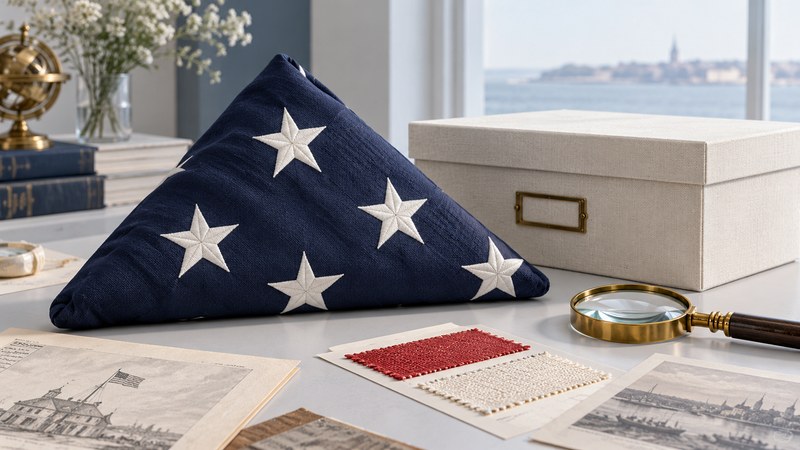
The American flag connects a changing union of states with the thirteen original colonies. Understanding that history makes older flags easier to read. For today's display questions, identify the setting first, then use the relevant part of the Flag Code and any applicable proclamation.
Read the design through its history
The current flag has fifty white stars in a blue field and thirteen alternating red and white stripes. The stars represent the states; the stripes recall the original colonies. The fifty-star design took effect July 4, 1960, following Hawaii's admission. USAGov's national-symbols guide provides an official overview.
- 1777: Congress's first Flag Act specified thirteen stars and thirteen stripes.
- 1794: A second act provided for fifteen stars and fifteen stripes as Vermont and Kentucky joined the union.
- 1818: Congress returned the stripes to thirteen and established one star for each state, with additions taking effect on the following July 4.
The Smithsonian's account of the Star-Spangled Banner explains why the surviving Fort McHenry flag has fifteen stars and stripes. Mary Pickersgill and her team made the large garrison flag in 1813. Its design belongs to that historical moment; counting its stripes helps explain the object.
Looking at an old flag
Record the star count, arrangement, materials and any known provenance. Then compare the design with a documented historical example. A design associated with a period is a clue, while the object's manufacture and use still need evidence. A reproduction can copy an earlier design exactly.
Match the display guidance to the setting
For routine outdoor display, 4 U.S.C. § 6 describes sunrise-to-sunset custom, with nighttime display when properly illuminated. It calls for an all-weather flag in inclement weather, brisk raising and ceremonial lowering. Choose a suitable location and follow the hardware manufacturer's installation instructions.
| Setting | Orientation or arrangement |
|---|---|
| Flat against a wall | Horizontally or vertically, place the blue union uppermost and to the viewer's left. |
| In a window | Use the viewpoint of a person outside in the street: blue union at their upper left. |
| On a staff beside a speaker | The U.S. flag occupies the speaker's right, which is the audience's left. |
| With other nations' flags in peacetime | Use separate staffs of the same height and flags of approximately equal size. |
These settings have different viewpoints. Stand where the intended observer will be before fastening the flag. For crossed staffs, state flags on a halyard, corridors or processions, consult the specific arrangement in § 7.
Check the actual half-staff instruction
Use USAGov's half-staff resources to find the applicable notice. Read the issuer, places covered, start and end dates, and any end time. A photograph of a lowered flag or an old announcement provides too little context for today's decision.
Section 7 describes briefly raising the flag to the peak before lowering it to half-staff, and returning it to the peak before lowering it for the day. Memorial Day has a specific pattern: half-staff until noon, then the peak. Record any special instruction with the date so the next person managing the display knows when to change it.
Care for the flag and assess its condition
4 U.S.C. § 8 addresses respectful handling: keep the flag clear of the ground and other objects beneath it, and fasten or store it in a way that avoids damage. Follow the fabric maker's cleaning instructions and inspect seams, attachment points and fading before returning it to display.
When its condition makes it unsuitable for display, the code calls for dignified destruction, preferably by burning. A practical option is to ask a local veterans organization whether it accepts flags for a retirement ceremony. Confirm its process before dropping one off. Treat retirement as an organized service rather than improvising a fire at home.
Preserve a historically significant or personally important flag through appropriate conservation advice. The Star-Spangled Banner's museum history shows that a fragile flag can also be an artifact to study and protect.
Understand the role of the Flag Code
The Congressional Research Service's flag-law FAQ (PDF) explains that most Flag Code provisions lack explicit enforcement mechanisms and operate as advisory guidance. Specific legal questions may also involve constitutional protections, local rules or an institution's policies. This display guide should be used within that scope.
The related Pledge of Allegiance guide covers wording, historical changes and the distinction between ceremonial guidance and compelled recitation. Return to the United States library for more resources.
Sources and review
Historical sources: Smithsonian and USAGov. Display sources: the Government Publishing Office's 2024 U.S. Code edition, §§ 6–8, and CRS. Reviewed October 7, 2026. Use current official notices for half-staff instructions and check later legal changes for a specific legal question.