Choose an aluminum boat by the water you use, the load you carry and the way you launch and store it. Hull geometry, construction quality, condition and support matter together. A material label or a welded-versus-riveted slogan leaves much of that decision unanswered.
For recreational buyers and owners. Use the builder’s documentation for the exact hull; structural repairs, corrosion diagnosis and equipment alterations may need specialist assessment.
Begin with the water and the work
Describe an ordinary trip: where you launch, how far you travel, usual people aboard, gear, fishing style and available storage. A small portable boat, a shallow-water utility hull and a larger deep-V fishing boat solve different problems even when all are built from aluminum.
Look at the range of hull types in Lund’s aluminum lineup as examples of those choices. The depth and shape of the hull, freeboard, layout and approved loading should fit the intended conditions. Ask to evaluate a candidate on representative water with a competent operator and suitable conditions.
Include practical handling on land. Can you reach the ramp, store the complete rig, board comfortably and manage the equipment with the people who will normally help? Obtain the actual loaded boat-and-trailer weight before relying on a vehicle’s towing capability.
On a narrow screen, scroll the table sideways. Keyboard users can focus the table and use the arrow keys.
| Need | Inspect or ask | What a useful answer looks like |
|---|---|---|
| Sheltered fishing or utility use | Hull layout, usable floor space and seating | A configuration that supports the task within its documented limits |
| More exposed water | Builder’s intended use, freeboard, handling and load information | A suitable hull and operating plan for the conditions |
| Frequent launching | Trailer fit, loaded weight and ramp access | A matched combination with practical retrieval arrangements |
| Seasonal or afloat storage | Coatings, drainage, corrosion protection and local service | A documented care plan for the actual environment |
| Electronics and added batteries | Mounting locations, total weight and electrical installation | A builder-approved installation with service access |
Compare complete structures
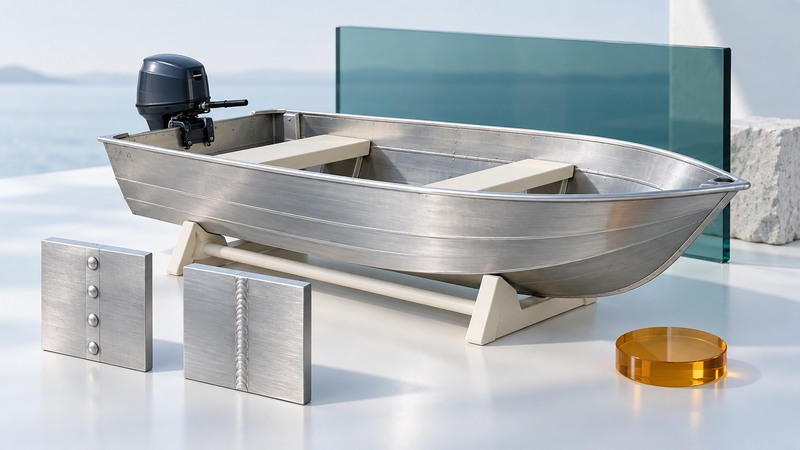
Rivets mechanically join overlapping parts; welding joins metal along the seam. Lund describes double-riveted seams in its construction, while Lowe describes continuously welded seams in its fishing boats. Both are real production approaches. Their marketing descriptions do not establish that one method wins for every boat and use.
Ask about hull plating, framing, transom design, deck materials, access for inspection and repair, and the manufacturer’s warranty terms. A thicker plate in one area is only part of the structural arrangement. Request comparable specifications instead of comparing a single headline thickness.
On a used boat, condition and repair history deserve particular weight. A well-documented original hull and a heavily altered hull should not be treated as equivalent merely because they share a construction method. Ask who performed repairs, what was repaired and whether the builder or an appropriate specialist approved the work.
Look for a local shop that understands the particular construction before purchase. Obtain a realistic view of service availability and access to replacement parts. Read warranty transfer conditions directly; a seller’s statement about remaining coverage needs confirmation.
Inspect the hull and its history
Use an initial viewing to identify questions for a qualified surveyor or repair specialist. With the seller’s permission, inspect accessible seams, welds, rivets, transom attachments and the hull bottom. Note dents, distortion, cracks, missing fasteners, previous patches, damaged coatings and areas of pitting.
Check inside lockers and around fittings for trapped water, staining and improvised wiring or mounting. Ask about long-term immersion, storage after use and the type of water in which the boat operated. Photograph findings and compare them with the repair records. A coating can improve appearance while leaving questions about the metal underneath.
A dent’s significance depends on its location, extent and associated damage. Likewise, visible corrosion needs assessment of its cause and remaining material. Seek an appropriate inspection when the answer affects integrity or cost. Agree any leak testing or access with the specialist; avoid improvised pressure tests or loading the hull with water.
For a complete purchase process, use the used-boat guide and the BoatUS preliminary condition checklist. Include the engine and trailer in the evidence file rather than treating them as incidental extras.
Prevent incompatible materials and trapped moisture
The Lund owner’s manual describes galvanic corrosion associated with dissimilar metals and calls for appropriate freshwater cleaning and care. Aluminum hulls need attention to fasteners, attached equipment, coatings and wet contact areas. An owner should identify and correct the source of corrosion, not merely cover a damaged patch.
Before adding hardware, paint, flooring or a battery system, ask the builder which materials, isolation methods and products are approved for the hull. Use coatings expressly suitable for aluminum and the intended immersion conditions. A product intended for another hull material may be unsuitable.
Keep drains and accessible spaces maintained according to the boat’s instructions. Report persistent water accumulation and unexpected corrosion. Electrical faults in a marina or onboard system require a qualified marine technician; changing anodes without investigating the cause may leave the underlying problem unresolved.
Trailer support also affects care. Load Rite’s overview discusses compatible bunk treatment for metal hulls and the risk of moisture trapped at contact areas. Have the trailer and boat suppliers confirm appropriate support materials and geometry for your combination.
Make the comparison specific
Ask for a complete quote that includes the engine, trailer, required equipment, commissioning and any planned additions. Keep comfort upgrades separate from necessary work. At handover, obtain manuals and learn the boat’s care, loading and transport arrangements.
Revisit the original brief whenever major equipment changes. Added fuel, batteries, platforms or engines can change weight distribution and support needs. Confirm the finished configuration with the builder or qualified installer before use.