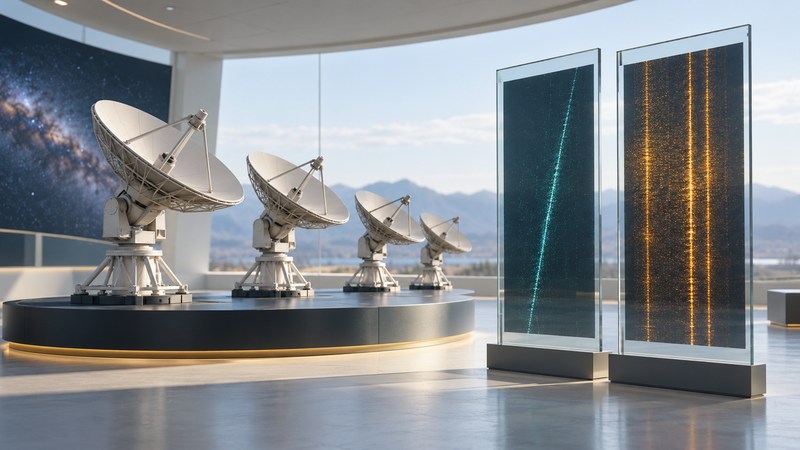
The Allen Telescope Array searches for radio technosignatures: signals whose properties might indicate technology beyond Earth. Reading a SETI result means following the signal through interference checks, localization, repeat observations and the limits of the search. A promising pattern is the beginning of an investigation; the strength of the conclusion comes from those tests.
What the array contributes
The SETI Institute's ATA project description lists 42 antennas at Hat Creek in northern California. The facility supports radio astronomy as well as dedicated SETI work. An observing paper's configuration is the relevant one for its result: the total number of installed dishes need not equal the number used in a particular campaign.
Combining antenna signals can produce narrow receiving beams within a wider field. This lets researchers compare a target direction with other directions. For the distinction between collecting area, angular resolution and imaging, start with the radio-array guide; here the central question is whether a signal behaves like a source in the intended direction.
Read a frequency–time display
A waterfall plot usually places frequency on one axis and time on the other, with color showing signal strength. First read the axes and units: a bright stripe shows power concentrated in a frequency range, and a sloping stripe shows its frequency changing over time. Plot orientation and color scales vary.
Relative acceleration can produce a frequency drift. Transmitter electronics and human interference can also make changing patterns, so a slope needs interpretation alongside the observing setup. Record center frequency, bandwidth, integration time, drift convention and signal-to-noise measure before comparing plots.
Follow the candidate through its tests
| Test | Evidence to inspect | Interpretive limit |
|---|---|---|
| Direction | Relative strength in target and comparison beams. | Beam sidelobes and calibration affect the comparison. |
| Interference | Related signals at other frequencies, local transmitters and instrumental patterns. | An unfamiliar signal can still have a human source. |
| Time behavior | Persistence, drift and repeat observations. | Intermittency and observing gaps affect what can be excluded. |
| Independent confirmation | Another instrument or observatory with appropriate sensitivity. | A failed follow-up is informative only within its coverage. |
| Search validation | Recovery of test signals and documented selection criteria. | Selection favors some signal forms over others. |
The published verification framework for blc1 shows why several tests belong together. That candidate came from Parkes observations toward Proxima Centauri, a separate experiment from the ATA. Detailed comparison with related interference supported a human-generated explanation. A target-only appearance in an initial selection was insufficient to settle the origin.
A real ATA example: TRAPPIST-1
A 2024 study analyzed 28 hours of ATA observations made in October–November 2022 across 0.9–9.3 GHz. It used simultaneous target and comparison beams to filter narrowband candidates and reported no signal of non-human origin. Its observing windows included predicted alignments of pairs of planets, motivated by a hypothetical opportunity to receive transmission spillover.
The paper's methods and observing table show which frequencies were observed on which dates. Such a campaign samples a defined region of frequency, time, direction and signal behavior. It does not provide uninterrupted coverage of every band for the full 28 hours.
Report a nondetection with its sensitivity, drift range, observation times and assumed transmission geometry. Equivalent isotropic radiated power is the power an isotropic transmitter would need to produce the same received flux at that distance. A limit on this quantity constrains a hypothetical transmitter under the search assumptions; a directed beam requires additional geometric context.
Keep the conclusion proportional to the search
A useful reading note contains the target, facility, observing dates, frequency coverage, time resolution, signal classes searched, interference rejection and follow-up status. Add the paper version and the exact quantity limited by a nondetection. This makes two surveys comparable without treating different selection rules as equivalent.
The SETI detection protocols emphasize verification and independent scrutiny before treating a result as evidence of extraterrestrial intelligence. The same discipline helps with ordinary headlines: preserve the difference between a software hit, a candidate retained for study and an interpretation supported by multiple checks.