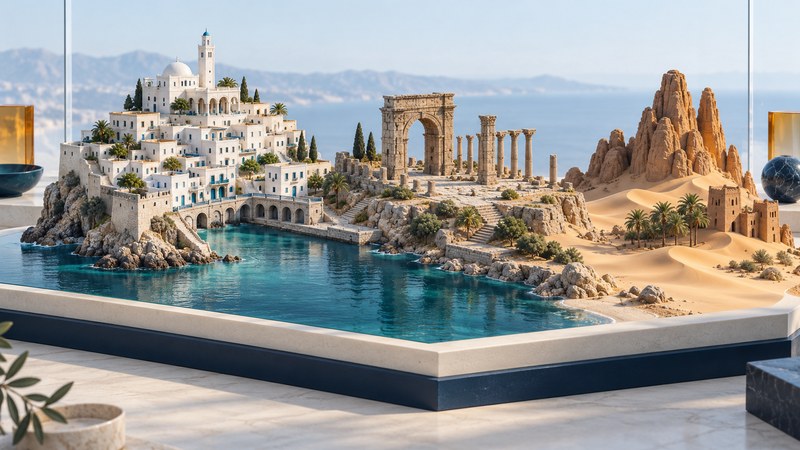
Plan an Algeria journey around the places you most want to understand: Algiers and the Mediterranean coast, Roman cities and inland heritage, or a carefully organized Sahara itinerary. Start with a manageable route, then settle entry documents, regional advice and transport before booking.
Start with the kind of Algeria trip you want
Algeria rewards a focused itinerary: the white hillside city of Algiers, Mediterranean archaeological sites, the bridges of Constantine, western cities and the immense landscapes of the Sahara offer very different journeys. For a first visit of about a week, choose Algiers and one northern region. Give a desert journey its own planning time, transport arrangements and specialist local support.
Before committing money: identify the consulate responsible for your passport and residence, check your government's advice for every part of the route, and confirm how you will move between overnight stops. These three checks determine which of the ideas below fit your trip.
Where to go: choose a coherent route
Algiers and Tipasa: a rewarding first base
Begin in Algiers with the Casbah, the historic hillside quarter, and allow another day for the city's waterfront, gardens or museums according to your interests. UNESCO describes the Casbah's traditional houses, palaces and mosques as a living urban fabric adapted to steep terrain. A knowledgeable local guide adds historical context and helps organize a workable walking route. Ask about stairs and the vehicle drop-off point if mobility or heat is a concern.
Set aside a separate excursion for Tipasa's coastal archaeological remains, where Punic, Roman, early Christian and later layers meet the Mediterranean. Agree which site entrances and any museum visit your excursion includes. Bring sun protection and shoes suited to uneven ground; arrange the return transport before setting out.
Constantine, Djémila and Timgad: give the east enough time
Constantine makes an appealing city stop for its dramatic setting and bridges. For archaeology, choose the site that fits your onward route: Djémila, the Roman town of Cuicul, shows how a town was fitted to mountain terrain; Timgad is known for its legible Roman street grid. These are separate outings. Ask a driver or operator for door-to-door travel time and time on site before combining either with a transfer day.
Oran and Tlemcen: a western alternative
Choose the west for Oran's coastal setting and Santa Cruz landmark, then Tlemcen's architectural heritage. The Algerian tourism ministry's country overview introduces these western highlights alongside other regions. For a short holiday, this pairing can replace the eastern circuit. Staying in both regions on the same week-long trip leaves much less time to explore either.
Ghardaïa and the M'Zab: living settlements
The M'Zab Valley's five fortified settlements reflect an urban tradition developed around community life and the desert environment. Arrange local interpretation and ask which areas welcome visitors, when visits are possible and what photography rules apply. Treat residential lanes, markets and places of worship as lived-in spaces. Ghardaïa needs its own transport and overnight plan; it is a separate addition to a northern route.
Djanet and Tassili n'Ajjer: a specialist desert journey
The sandstone landscapes and prehistoric rock art of Tassili n'Ajjer are compelling reasons to investigate a Sahara trip. Start with a Djanet-based operator and a named, detailed route, then compare that route with current advisories and permitted access. Ask whether the proposed days involve vehicle travel, substantial walking, camping or a combination. A photograph of dunes tells you little about the physical demands of the actual itinerary.
Ask for the agency's accreditation, guide language, group size, exact overnight locations, permits, communications plan and emergency arrangements in writing. Establish who provides drinking water, meals, sleeping equipment and transport if weather or access changes. Leave rock art untouched and follow the guide's conservation instructions. A tour booking does not override a government warning or an insurance exclusion.
On a narrow screen, scroll this table sideways. Keyboard users can focus it and use the arrow keys.
| Trip shape | A useful starting plan | Main decision |
|---|---|---|
| One week in the north | Algiers and Tipasa, plus one eastern or western base | Choose between Constantine and archaeology, or Oran and Tlemcen. |
| A slower northern trip | Spend roughly 10–14 days across two regional clusters | Reserve full transfer days and keep an uncommitted day. |
| A Sahara-focused visit | Build dates around an approved operator itinerary and confirmed flights | Settle route permissions, regional advice, physical demands and emergency support first. |
| North plus Sahara | Add a separately planned desert block and connection buffers | Price the whole itinerary and allow recovery time after a disrupted domestic connection. |
These are editorial planning suggestions, not fixed tour durations or transport schedules. Actual dates depend on available services, access, your walking pace and the time you want at each place.
When to visit
Choose the season by region. Algeria's tourism ministry describes a Mediterranean north with hot, dry summers and cooler, wetter winters, semi-arid high plateaux and desert conditions farther south. For walking in northern cities and ruins, spring and autumn are sensible starting points. For a Sahara itinerary, discuss the cooler part of the year with your operator; daytime heat and cold nights require different clothing and arrangements.
Check a forecast for each overnight location just before departure. A coastal forecast gives little guidance for an inland plateau or desert camp. Ask about seasonal site hours and any weather-related route changes. If your dates overlap Ramadan, confirm meal arrangements, opening hours and the daily rhythm with your hosts before fixing sightseeing times.
Visas, passports and arrival documents
Visa requirements depend on nationality, passport type and residence. The Algerian foreign ministry's visa guidance directs applicants to the diplomatic or consular post for their usual residence and lists supporting documents such as accommodation evidence. Get that post's current checklist, fee, submission method and processing advice before making nonrefundable commitments.
- US residents: check jurisdiction first. The Washington embassy's visa page serves DC and specified states and directs other US residents to the consulate in New York. Its requirements include a passport with six months' validity and documents supporting the tourism booking.
- British-citizen passport holders: UK entry guidance states that a visa is required and the passport must expire at least six months after arrival. Check the consulate's instructions for your residence.
- Southern tours: Algeria has published a special agency-arranged visa-on-arrival procedure involving an accredited agency, an agreed itinerary and a QR-coded boarding authorization. The announcement calls the arrangement exceptional and temporary. Confirm current eligibility, your complete route and the documents the airline will accept with the agency and consulate before travel. An ordinary hotel reservation alone is insufficient evidence for relying on this procedure.
When documents arrive, check names, passport details, validity, permitted stay and entries against the trip. Carry accessible copies of accommodation and transfer confirmations. Dual nationals and families travelling with children should check the specific entry and departure documentation that applies to them; the UK entry page includes relevant family-document guidance. Review health-entry requirements for your departure and transit countries too.
Check safety by route and traveller
As checked on October 3, 2026, the US State Department advises increased caution overall, with do-not-travel advice for specified eastern and southern border areas and named regions, and for remote Sahara travel without an organized tour group. Its listed regions include Tamanrasset; a popular destination name is insufficient evidence that a route is suitable. Read the complete current list.
The UK FCDO regional advice and map use different geographic boundaries, including restrictions around several international borders. Check your own government's advice and your insurer's conditions against the actual roads, excursions and camps, not just the arrival airport. Seek written clarification where coverage or geography is unclear.
For city visits, FCDO's safety guidance recommends a good local guide for the Casbah and hotel-recommended taxis. Keep hosts informed of your plans, avoid demonstrations and arrange an evening return in advance. The same guidance covers identity documents and local laws, including the criminalization of same-sex sexual relations. LGBT+ travellers should assess that legal context before choosing the trip.
Discuss vaccinations and your personal health needs with a qualified travel-health professional before departure. Official health guidance stresses checking local care and insurance for treatment and evacuation. For remote travel, ask how an evacuation would actually be organized and paid for. Save your insurer's assistance number, embassy contact and accommodation contact offline.
Getting there and moving between places
Build the route around confirmed transport. Use the Air Algérie booking system to investigate flights for your dates and verify the operating carrier, airport, baggage allowance and change conditions on the actual ticket. Domestic operations and availability can change; ask the operator to confirm every segment in a desert package. Leave a buffer before an international departure when returning on a separate domestic booking.
For northern rail travel, consult SNTF's official train search and service notices. Verify the exact station, departure day, ticketing arrangements and arrival time locally. Save the confirmed service details rather than planning around an undated timetable screenshot.
For archaeological excursions or multi-stop journeys, request a driver quotation that specifies vehicle, route, pickup, waiting time, stops and the return. Ask whether local notification, permits or escorts affect your chosen route. Compare the total door-to-door day with a flight or train, including airport or station transfers. Arrange your first airport pickup with the hotel or operator and keep the meeting point and fallback phone number offline.
For a multi-country trip, account for the closed Algeria–Morocco land border. Confirm the lawful, operating connection you intend to use before arranging either side of the journey.
Hotels, money and everyday travel
Choose a base that supports the day
Compare accommodation by the actual arrival route, access to meals, pickup arrangements and the part of the city you plan to explore. Ask about stairs, lifts, air conditioning, quiet rooms and breakfast hours. For wheelchair access, request specific information about the entrance, room, bathroom and vehicle; an “accessible” label leaves important details unanswered. Reconfirm late check-in and obtain any accommodation document needed for the visa.
Prepare a cash plan
The currency is the Algerian dinar, DZD. Canada's travel advice describes a cash-based economy, limited card acceptance beyond major hotels and unreliable foreign-card ATMs. Arrange a legal way to obtain local currency, verify payment methods with hotels and operators, and retain exchange receipts. Use authorized exchange services; street-market exchange is illegal.
Foreign-currency declaration and dinar import/export rules deserve a direct check with Algerian customs or your consulate before departure. Official foreign-government summaries differ on declaration thresholds. Confirm the rule for your nationality and residency, the amount you will carry and both entry and exit; retain the resulting declaration and receipts. Avoid building a budget around unofficial exchange rates.
Price flights, visas, rooms, transfers, guiding, entrance fees, meals, insurance, communications and a disruption reserve together. Ask whether a tour quote is per person or per group, which currency is payable, and what happens after a flight cancellation. This produces a useful budget without relying on a quickly outdated “daily cost.”
Food, communication and courtesy
Make meals part of the visit: ask hosts about local couscous preparations, soups, breads, pastries and seasonal dishes. Tell a guide or restaurant about allergies with the ingredients written in a language they can confirm they understand. Check actual ingredients and preparation rather than relying on a translated dish name.
Arrange a guide in your preferred language where interpretation matters. Download maps and save addresses in the form your driver or host uses. Confirm your mobile provider's roaming terms or local SIM arrangements, and test your connection before leaving a city. Keep essential confirmations available without a data signal.
Dress with local expectations in mind, ask before photographing people, and establish visitor and photography rules at religious sites. During Ramadan, follow local guidance on daytime eating and drinking in public. Check consular or customs advice before packing specialist photographic equipment or a drone, and ask before photographing security personnel or installations.
A manageable first itinerary
Example: seven days based in Algiers and Constantine
This is an illustrative pace for a northern trip, subject to confirmed transport and current advice.
- Day 1: arrive in Algiers, settle in and confirm the next day's guide.
- Day 2: visit the Casbah with a local guide; leave the afternoon flexible.
- Day 3: take an arranged Tipasa excursion and return to Algiers.
- Day 4: transfer to Constantine using a confirmed service; plan only a light evening.
- Day 5: explore Constantine at a comfortable pace.
- Day 6: return to Algiers, leaving a buffer before the international flight.
- Day 7: depart, or use remaining time according to the flight schedule.
To add Djémila or Timgad, add nights and a dedicated excursion or planned transfer stop. For Oran and Tlemcen, build a western version with its own verified connections. If the Sahara is your priority, start afresh with the operator's full route and flight plan instead of inserting it into this week.
Turn the route into a booking brief
Download the editable Algeria trip-planning brief. Fill in a separate overnight line for each date, then resolve these items before paying:
- Entry: responsible consulate, applicable visa procedure, passport validity, supporting documents and any family requirements.
- Route: named locations, confirmed connections, current regional advice and insurance acceptance.
- Booking: accommodation, guides, permits where needed, inclusions, payment currency and cancellation terms.
- Arrival and backup: pickup details, cash access, offline contacts and a plan for a delayed connection.
Send the same completed brief to each operator you are comparing. Ask them to mark what is confirmed, what depends on permission or availability, and which costs remain outside the quote. Choose the itinerary whose logistics you can explain clearly before departure.
Related travel resources
- Travel packages and separate bookings: compare the whole trip
- Choose a hotel by room, location and full cost
- Browse all travel guides
Researched and updated October 3, 2026. Recheck entry rules, regional advisories, transport and opening arrangements before booking and again before departure.