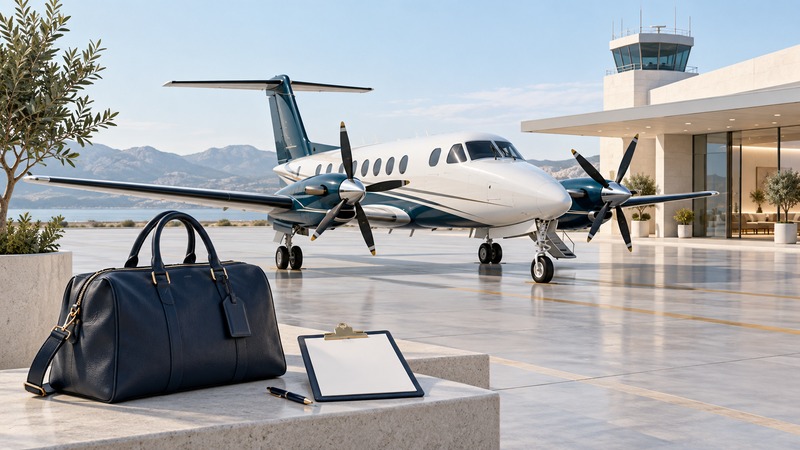
An air taxi can make sense when airport access, timing or a group itinerary makes scheduled service awkward. Evaluate it as a complete transport arrangement: the company operating the aircraft, the actual airports, what the quote includes and what happens if the plan changes. This guide addresses U.S. charter purchasing; another country’s civil aviation authority governs the corresponding checks there.
On a narrow screen, scroll tables sideways. Keyboard users can focus a table and use the arrow keys.
Identify who will operate the flight
The FAA’s Safe Air Charter guidance describes commuter and on-demand operations under Part 135 and highlights the importance of authorized operators and aircraft. Ask for the operating company’s legal name, certificate information and the aircraft proposed for the trip. If a broker arranges the journey, record the broker and operator separately.
The FAA’s passenger checklist links to licensed-operator information and the aircraft registry. Confirm operating authority using the FAA’s resources or the responsible Flight Standards office. An aircraft registration identifies an aircraft; charter authorization needs its own confirmation.
Resolve any attempt to transfer operational control to you before signing. The FAA flags arrangements that supply the aircraft and crew while shifting that responsibility to the consumer, as well as coaching passengers about what to tell inspectors. Choose a provider that answers authorization and contract questions clearly.
Ask for a comparable written quote
Send each provider the same dates, acceptable departure window, origin and destination, passenger count and baggage details. Describe bulky luggage, mobility needs and pets early so the operator can assess suitability. A cabin’s seat count alone leaves luggage and mission constraints unresolved.
| Question | Record in writing | Decision it supports |
|---|---|---|
| Who operates? | Legal operator, certificate, aircraft and substitution process | Verify the service and any replacement. |
| Where do we travel? | Exact airports, terminal or FBO address, ground transfer | Compare the whole journey. |
| What is included? | Flight, repositioning, waiting, airport charges, taxes and extras | Identify the total and possible additions. |
| What can change? | Weather, maintenance, delays, cancellation and refund terms | Plan a fallback and understand financial exposure. |
| Who helps? | Day-of-travel contact and after-hours arrangements | Resolve changes with the responsible party. |
An FBO is the airport service facility often used for a charter departure. Confirm its address with the operator; the main airline terminal may be a different place. Ask whether the quoted aircraft is committed, what alternatives are permitted and whether a replacement changes capacity or price.
Compare the trip cost and time
Fictional four-person journey
Suppose the charter flight quote is USD 6,000, with USD 800 of stated additional charges and USD 200 for ground transfers. Total: USD 7,000, or USD 1,750 per traveler for four people. A scheduled alternative costs 4 × USD 500 plus USD 300 ground transport, totaling USD 2,300. Charter costs USD 4,700 more for the group. These are invented all-in inputs, not market quotes or tax calculations.
Now compare the time from the same starting address to the same final destination. Include driving, the operator’s required arrival margin, flight duration, any stop and the final transfer. State assumptions for each. If charter saves two hours per traveler in this fictional comparison, that is eight traveler-hours; the extra group cost is USD 587.50 per traveler-hour saved. Decide whether that benefit serves the trip’s purpose.
Use the printable charter-comparison sheet with current written quotes. Keep price and timing assumptions visible instead of reducing the decision to an hourly aircraft rate.
Make the fallback part of the booking
Ask what happens if weather or maintenance prevents the flight: who decides, how you are notified, what replacement is offered and how refunds or additional costs are handled. Verify whether an empty-leg offer depends on another trip proceeding. A rigid meeting time deserves a backup that remains workable if the charter changes.
The term “air taxi” also appears in proposals for electric vertical-takeoff aircraft. Assess an available service by its specific aircraft, operator, authority and bookable route. A technology demonstration or future launch announcement supplies different evidence from an authorized service you can actually buy.
Before departure, reconfirm the aircraft, meeting location, passengers, luggage and contact number. Follow the operator’s briefing and requirements. A successful purchase leaves you with a verified operator, a complete quote, an arrival plan and a clear response if the itinerary cannot proceed.