Begin a private 5G project with a production task, a measured baseline and an acceptance test. The network is useful when it improves that task under the plant’s actual load, movement, interference and support conditions.
Choose connectivity by workload
| Option | Useful fit | What to investigate |
|---|---|---|
| Wired industrial networking | Fixed machines and established control systems | Cable routes, moving connections, maintenance access and required timing behavior. |
| Wi-Fi | Supported mobile devices and local data applications | Coverage, roaming behavior, congestion, authentication and application performance under load. |
| Private 5G | Provisioned mobile equipment across planned coverage areas | Spectrum access, modems, core and radio support, SIM lifecycle, integration and service ownership. |
Compare the same application requirement across these options. A general claim that one wireless technology is more reliable than another omits the configuration, environment and workload that determine the result. 3GPP’s industrial 5G overview describes mechanisms for industrial requirements; implementation and validation remain part of the project.
Write the pilot brief before buying equipment
Use the factory 5G pilot brief to capture a decision that operations, networking and the application owner can all assess.
- Task and baseline: identify the process, current failure or constraint, and the improvement that would justify a change.
- Traffic: list device counts, payload rates, bursts, directions, concurrency and growth assumptions. Camera traffic deserves an explicit uplink budget.
- Movement and space: record routes, speeds, floors, metal obstructions, outdoor transitions and layout changes.
- Acceptance: let the application owner specify endpoints, timing limits, allowed loss, interruption duration and observation period. Define how each will be measured.
- Operations: assign responsibility for subscriber provisioning, patching, monitoring, spare hardware and incident response.
Before a field trial, confirm device support for the proposed bands, network mode, local spectrum arrangement and features. Include integration labor and ongoing support, not just radio hardware, in the comparison.
Work through one bounded production task
The NIST testbed includes interference and path-loss scenarios in its evaluation. For a real pilot, agree representative adverse conditions and a safe test plan with the plant owner. Record failed attempts and recovery behavior as well as successful cycle times.
Design the camera and compute path together
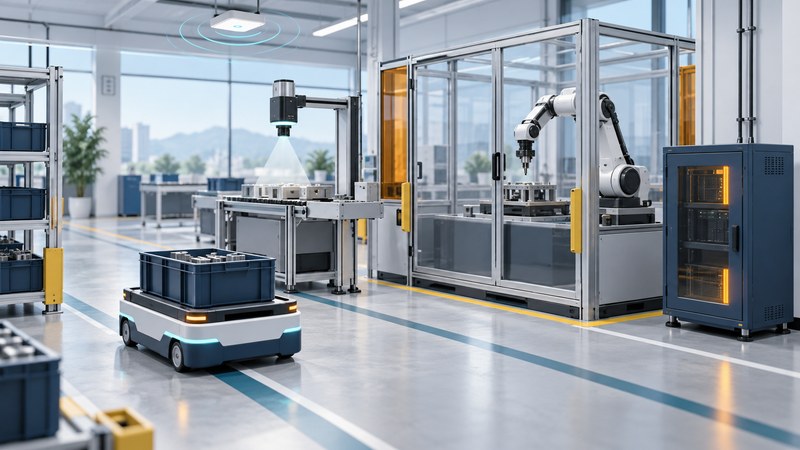
Machine vision can generate large data flows. Cameras may inspect welds, paint, labels, packaging, surfaces, dimensions, worker-safety zones, or machine behavior. Sending every raw video stream to a distant cloud is inefficient, so smart factories increasingly pair private 5G with edge computing.
Edge systems can process images near the production line, sending only alerts, measurements, quality records, or compressed results onward. This reduces backhaul demand and supports faster decisions. For a 5G smart factory, the network and edge platform should be designed together so camera placement, uplink capacity, compute, storage, and retention policies all match the production need.
Use a traffic budget to separate average load from bursts. Decide how long source images are retained and who can access them. The compute-placement guide follows a camera service through user-plane routing and local analysis.
Separate timing, availability and safety
3GPP’s Industrial IoT and TSN explanation describes time-sensitive integration and the 5G system’s role as a logical bridge in a TSN architecture. Establish the supported device, core, radio and integration functions for the chosen release and product combination. A private-network label alone does not establish bounded end-to-end delay.
Availability needs a boundary: radio service, application service or the complete production process. Define the observation period and what counts as downtime. Local processing can reduce reliance on a remote application, but local authentication, licensing, name resolution or management may still depend on external systems.
Functional safety is a separate engineering responsibility. Safety functions, hazard assessment, fallback behavior and any required certification belong to the machine and process safety design. A connectivity pilot should never stand in for that validation.
Test recovery and assign long-term ownership
A 5G smart factory connects operational technology to software-defined networks, edge platforms, device identities, and cloud services. That expands the security surface. Manufacturers need segmentation, strong authentication, patch management, monitoring, incident response, vendor governance, and clear separation between business IT and production-critical systems.
Private 5G can help by giving the plant more control over subscribers, SIM or eSIM identity, traffic routing, and local data handling. It still needs disciplined security architecture. A wireless production network should be treated as critical infrastructure and managed with the same seriousness as other production systems.
Plan controlled tests of WAN loss, application restart, failed subscriber onboarding and radio/edge maintenance. Agree who may conduct each test and how production remains protected. Observe recovery time, lost or duplicated records, and whether a session resumes correctly.
Include subscriptions or spectrum arrangements, device replacement, certificates and SIMs, software support, edge power/cooling, logging, training and decommissioning in lifecycle costs. Accept the pilot only against the written outcomes, with known limitations and an owner for unresolved work.