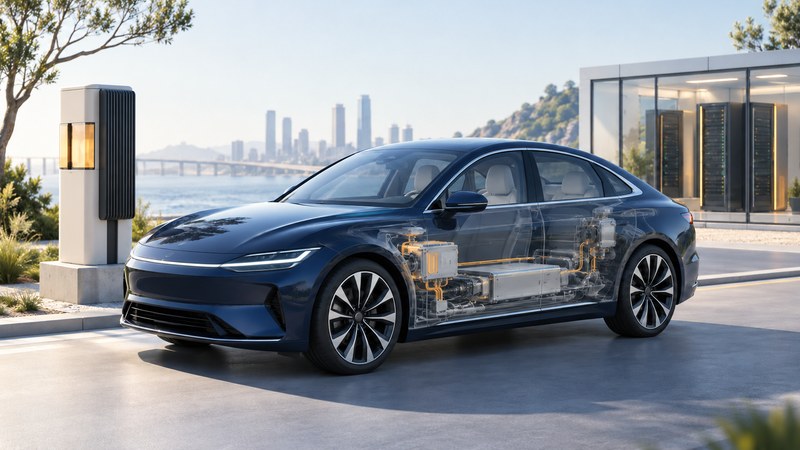
A connected vehicle can use remote services, exchange local messages and process information onboard. Understanding those three paths helps you judge a feature’s coverage needs, equipment requirements and behavior when a connection is unavailable.
Identify the communication path
| Path | Example | What must be present |
|---|---|---|
| Vehicle → mobile network → service | Remote diagnostics, map downloads or a fleet dashboard | Supported modem and service, coverage, account entitlement and an operating backend. |
| Vehicle ↔ nearby compatible participant | Direct C-V2X sidelink exchange | Compatible radio technology, message implementation, spectrum authorization and participants. |
| Onboard sensors → local processing | Vehicle perception and control functions | The vehicle’s designed sensors, software, operating conditions and driver responsibilities. |
5GAA’s technology explanation distinguishes direct and network-based communication. 3GPP Release 16 includes NR V2X work. LTE-based C-V2X and NR V2X have distinct radio capabilities; verify the actual equipment and interoperability rather than treating every “V2X” label as interchangeable.
- Cloud service ↔ mobile network ↔ vehicle modem
- Nearby participant ↔ compatible direct radio
- Onboard sensor → onboard processing
These are separate logical paths. A supported vehicle system decides how information is validated and used; the diagram is not a control-system design.
What an early connected-car trial established
In NTT DOCOMO’s November 2017 report, a multi-party trial with Toyota, Ericsson and Intel streamed 4K video using a 5G link in a moving vehicle. The report gives downlink and uplink results under specified trial conditions at 30 km/h. It demonstrated a communications capability in that setup.
To compare such a demonstration with a service you might use, ask about route coverage, modem and antenna configuration, concurrent users, the traffic directions and interruptions. Streaming video in a test vehicle supplies different evidence from validating an automated-driving function.
Match the service to its outage behavior
| Service | Ask about normal operation | Ask about loss of connectivity |
|---|---|---|
| Navigation and traffic | Map region, update method and data plan | Available offline maps and freshness of saved information. |
| Remote app controls | Account ownership, supported functions and backend support period | Which controls need a live network and what the vehicle supports locally. |
| Fleet video and telemetry | Upload rate, retention, access and employee policy | Local buffering, later upload, duplicate records and storage limits. |
| Software updates | Signed updates, installation conditions and support policy | Interrupted download, installation recovery and clear status reporting. |
| V2X awareness | Compatible vehicles/infrastructure and approved operating region | How missing or stale messages are handled by the implemented feature. |
Check the owner’s manual for the exact model, market and software version. A subscription, network upgrade or advertised future feature can change what is available. Keep the distinction between a feature installed in the vehicle and a service maintained by an external provider.
Keep automation and connectivity distinct
A connected car exchanges data with cloud services, infrastructure, other vehicles, road users, or fleet systems. An automated car performs some or all driving tasks under defined conditions. The two ideas reinforce each other, yet they solve different problems. Connectivity helps a vehicle know more about the road network; automation determines how the vehicle behaves.
This distinction matters for safety expectations. A vehicle should handle immediate safety-critical decisions with onboard systems, because cellular coverage can vary and networks can be congested, blocked, or unavailable. 5G adds useful context: traffic signal timing, work-zone warnings, hazard alerts, map updates, cooperative perception, and fleet learning.
Assess driver responsibilities and the permitted operating conditions from the vehicle’s documentation. Direct messages and remote data can add context; the system still needs a defined response to delayed, inconsistent or unavailable information. Connectivity claims alone do not establish an automation capability.
Ask about privacy and the service lifetime
A connected vehicle expands the security perimeter. Cellular modems, cloud services, mobile apps, roadside units, update servers, fleet dashboards, diagnostics ports, and third-party services all need protection. Vehicle data can reveal location, habits, driving behavior, passenger routines, and business operations, so privacy governance is part of the technical design.
Good connected-car architecture separates safety-critical systems from infotainment and external services, authenticates messages, encrypts sensitive data, monitors anomalies, and limits collection to what the service requires. Trust is as important as bandwidth.
- Which location, diagnostic, camera and occupant-related data are collected, and for which purposes?
- Which settings affect sharing, and which functions change when sharing is disabled?
- How are previous owners, rental users and linked phones removed from the account?
- What is the stated support period, and what happens when a subscription or backend service ends?
- Who supports the embedded modem, eSIM and emergency features when the vehicle changes hands?
For a fleet, assign access by job role, define retention and verify export/deletion procedures. For an owner, review account links and service terms before selling or returning the vehicle. Keep records of the support commitments that matter to your use.